5 Essential Temperature Measurement Devices for Everyday Life
In our daily routines, we constantly interact with changes in temperature—whether it’s feeling the heat of a freshly brewed cup of coffee, the chill of ice cubes, or noticing how a metal spoon warms up when left in a hot bowl. While our skin can sense hot and cold, it can’t tell us exact temperatures or help us compare different environments. That’s why Temperature Measurement Devices are such vital tools in our lives.
Temperature Measurement Devices come in many forms, from the classic glass thermometer to advanced digital sensors and infrared cameras. These instruments allow us to accurately measure temperature in homes, hospitals, schools, and workplaces. In the kitchen, Temperature Measurement Devices help ensure food is cooked safely and perfectly. In healthcare, they play a crucial role in monitoring body temperature and diagnosing illnesses.
But the importance of Temperature Measurement Devices goes beyond personal comfort and health. In industries and laboratories, these devices help maintain safe and efficient operations by monitoring equipment and processes. Weather stations rely on Temperature Measurement Devices to provide accurate forecasts, while environmental scientists use them to study climate patterns and changes.
Without Temperature Measurement Devices, many of the conveniences and safety features we take for granted would not be possible. These tools make the invisible world of heat and cold visible, giving us the information needed to make smart decisions and take timely action. Temperature Measurement Devices are truly indispensable, shaping our understanding of temperature and its impact on everything from our health to the environment and technology. By using Temperature Measurement Devices, we can explore, manage, and benefit from the science of temperature every day.
Daniel Gabriel Fahrenheit
Daniel Gabriel Fahrenheit (1686–1736) was a Dutch scientist and instrument maker who made significant contributions to the field of temperature measurement. In 1714, he invented the first reliable mercury thermometer, offering far greater accuracy and consistency than earlier alcohol or water-based instruments.
Fahrenheit introduced his own temperature scale in 1724, which quickly gained widespread acceptance due to the precision of his thermometers. This scale, known as the Fahrenheit scale, remains important and is still used in many countries today.
What is Heat?

Every substance is made up of countless tiny particles known as molecules. These molecules move in different ways depending on whether the substance is solid, liquid, or gas, and also according to its temperature. Molecules can move along straight lines (translational motion), vibrate back and forth around their average positions (vibrational motion), or rotate around their own axes (rotational motion).
Each type of molecular motion gives the molecules—and therefore the body—kinetic energy. The total thermal energy, or heat, of a body is the sum of the kinetic energies from all its molecules’ translational, vibrational, and rotational motions. When a hot cup of tea is left on a table, it gradually cools down; when ice-cold water is left out, it slowly warms up. In both cases, heat moves from the object with a higher temperature to the one with a lower temperature, as long as they are in contact. Heat is thus a form of energy that transfers between objects due to temperature differences. The standard international (SI) unit for measuring heat is the joule.
What is Temperature?

Many people mix up temperature with heat, but they are distinct concepts. Temperature describes how hot or cold an object feels—it’s a measure of the average kinetic energy of its particles, not the total energy. When two objects at different temperatures touch each other, heat flows from the warmer one to the cooler one until both reach the same temperature. In this way, temperature determines the direction of heat transfer between objects in contact.
Different Types of Temperature Scales
To measure temperature quantitatively, we use Temperature Measurement Devices like thermometers. Every thermometer is calibrated to a specific temperature scale, requiring two reliable reference points: usually, the freezing and boiling points of water at standard pressure. These are known as the ice point and the steam point.
Celsius Temperature Scale:
Developed by Anders Celsius in 1741, this scale sets the freezing point of water at 0°C and the boiling point at 100°C. The gap between these points is split into 100 equal parts, each representing one degree Celsius.

Fahrenheit Temperature Scale:
Introduced by Gabriel Fahrenheit in 1717, this scale marks the freezing point of water at 32°F and the boiling point at 212°F. The 180 divisions between them mean each degree Fahrenheit is smaller than a degree Celsius.

Kelvin Temperature Scale:
Widely used in science, the Kelvin scale is absolute, starting at absolute zero (0 K). Water freezes at 273.15 K and boils at 373.15 K. Unlike Celsius and Fahrenheit, Kelvin has no negative values.

Exploring Temperature Measurement Devices
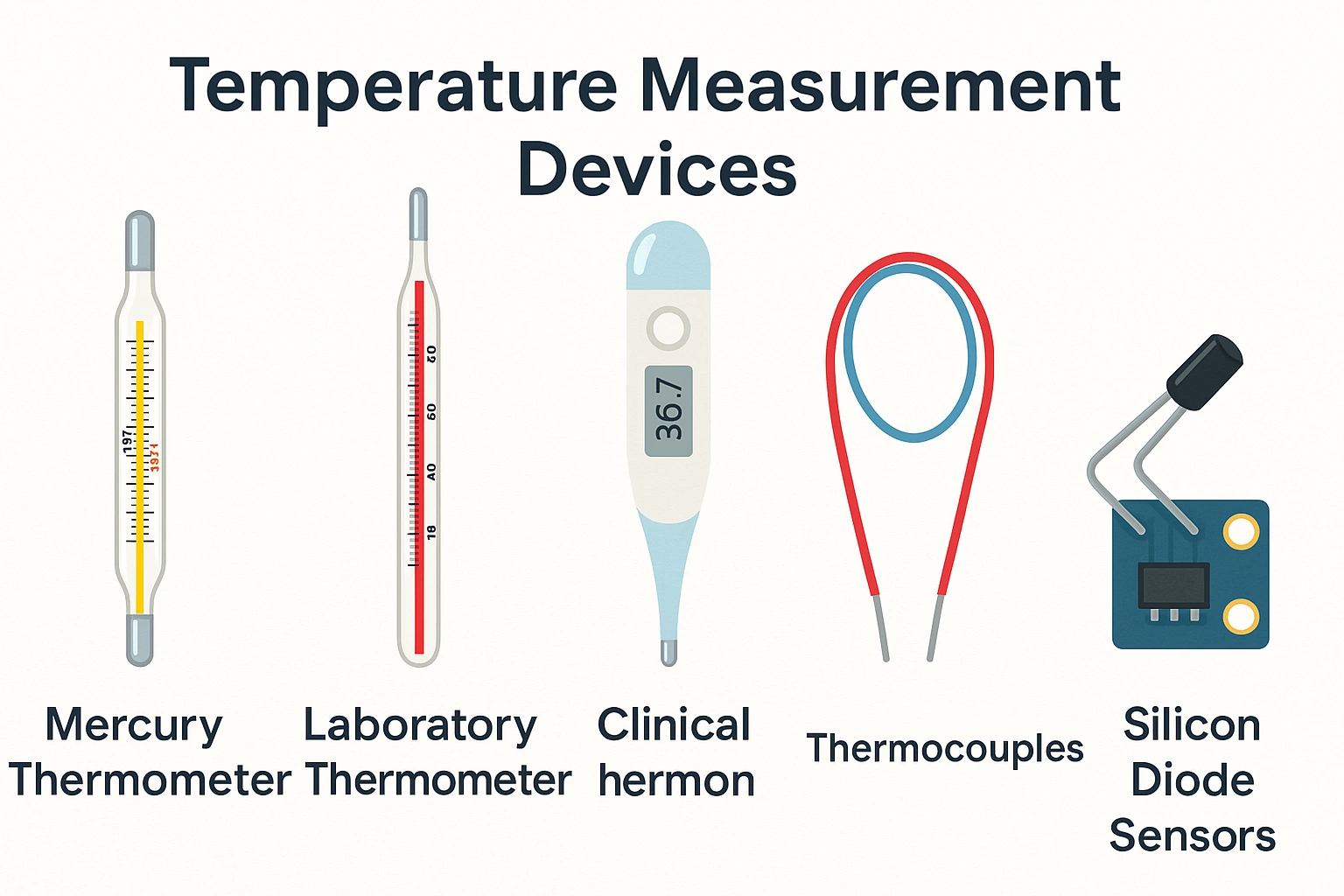
Today, Temperature Measurement Devices come in many forms, each suited for different needs:
- Mercury Thermometer: Invented by Gabriel Fahrenheit (note: actually much earlier, but popularized by him), this classic Temperature Measurement Device uses mercury in a glass tube to indicate temperature. As mercury expands with heat, it rises up the calibrated tube.

- Clinical Thermometer: Found in homes and hospitals, this Temperature Measurement Device features a kink that keeps the mercury in place after use, making it easy to read body temperature. It typically ranges from 35°C to 42°C.

- Laboratory Thermometer: Used in labs and industries, this Temperature Measurement Device has a longer stem and bulb than a clinical thermometer and measures a wider range, from about -10°C to 110°C.

- Thermocouples: These Temperature Measurement Devices generate voltage changes in response to temperature. The output voltage increases with temperature, providing accurate readings even in harsh environments.

- Silicon Diode Sensors: Designed for very low (cryogenic) temperatures, these Temperature Measurement Devices rely on the linear increase in diode conductivity as temperature drops.

Fun Facts about Temperature Measurement Devices
The first Temperature Measurement Devices used water, but since water freezes at 0°C (32°F), inventors switched to mercury and alcohol for better range and reliability. All liquid-based Temperature Measurement Devices work on a simple principle: as the liquid warms, it expands, showing a rise in temperature.
From ancient water-filled tubes to modern digital sensors, Temperature Measurement Devices have evolved to help us understand and control the world around us. Whether in the kitchen, lab, or factory, these tools are essential for making accurate temperature readings possible.
FAQ: Temperature Measurement Devices
1. What are the main types of Temperature Measurement Devices?
Common types include traditional thermometers (like mercury or digital), infrared sensors, and thermocouples. Each is suited for different uses, such as checking body temperature, monitoring room conditions, or measuring industrial processes.
2. How do Temperature Measurement Devices improve safety and efficiency?
These devices help maintain safe temperatures in homes by preventing overheating, ensure accurate cooking, monitor health in hospitals, and support industrial safety by preventing equipment failure.
3. Where are Temperature Measurement Devices used in everyday life?
Temperature measurement devices are used everywhere—in kitchens for cooking, in healthcare for checking fevers, in homes for climate control, and in industries to monitor machinery and processes.
Conclusion
In summary, this exploration has clarified the concepts of heat and temperature, highlighting the important distinctions between them. We have examined various temperature scales, such as Celsius, Fahrenheit, and Kelvin, which are essential for quantifying thermal conditions using Temperature Measurement Devices.
A wide range of Temperature Measurement Devices are available today, each tailored for specific applications. Traditional thermometers, which may contain mercury or another suitable liquid, operate based on the principle that fluid expansion is directly proportional to temperature. As temperatures rise, the fluid inside these Temperature Measurement Devices expands, causing the volume to increase in a predictable way—making it possible to accurately determine temperature.
Beyond classic thermometers, modern Temperature Measurement Devices include thermocouples and digital thermometers, which offer versatility and precision for both everyday and specialized uses. Temperature Measurement Devices are vital in settings from homes and hospitals to laboratories and industrial environments, ensuring safety, accuracy, and efficiency.
The evolution of Temperature Measurement Devices has made it possible to monitor and control temperature in countless scenarios, thanks to their reliability and adaptability. By understanding how Temperature Measurement Devices function, we gain valuable insights into the thermal properties of materials and the world around us. Ultimately, the ongoing development of Temperature Measurement Devices continues to shape our ability to measure, analyze, and respond to temperature changes with confidence and precision.
Curious about health tracking? See our Body Fat Measurement Device blog on Dimensions Path!
Temperature Converter